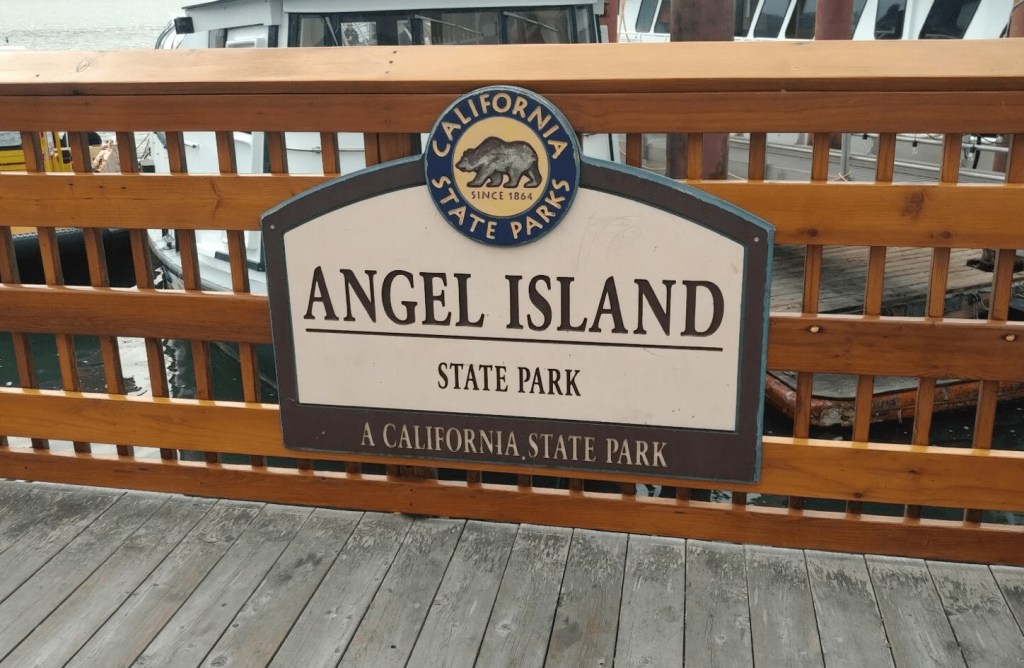
Angel Island State Park sits in San Francisco Bay, separated from the town of Tiburon by a ten minute ferry ride across Raccoon Strait. The island is also accessible by ferry from San Francisco’s waterfront.

Nearly all of the island is part of the State Park, so you can activate for POTA US-1123 from almost anywhere. However, if you want to also try for the SOTA activation from Mt. Livermore W6/CC-075 then you’ll need to hike up to the top of the island, by way of either of two trails.

My first activation of this summit and park combo took place two years ago, just before this blog begins. In that effort we used the recommended route of North Ridge trail up and Sunset trail down. This time my hiking buddy wanted the potentially spectacular Golden Gate views on the hike up so we did the route in reverse.

Sunset trail begins at the top of the access road that connects the perimeter road with the park HQ at the Ayala Cove area.

The trail follows a series of long switchbacks and is, in places, quite narrow with thorny vegetation overhanging the trail and parts of the trail collapsed on the downhill side.

However, as the “Sunset” name implies, there are occasional vistas that reveal the Golden Gate, Sausalito, and the western waters of the Bay.

After climbing out of the oak tree covered canyon the vegetation becomes more grassy and sparse. A short while later you come to an intersection with a steep, unnamed trail that takes you up into the activation zone and the summit.

A short section of this summit trail is so dense with shrubbery that you could fairly call it bushwhacking. And, if you have collapsible mast strapped to your pack, you will undoubtedly get hung up a few times before emerging onto the first of several concrete platforms that once served the operation of the Nike missile defense system stationed on the island in the 1950s.

The concrete pads now sport picnic tables and conveniently situated fence posts. We chose the first picnic area we encountered because it was available and I’d successfully operated from here before.
This site can be chilly as it’s exposed to the west winds coming from the Pacific. It turns out that just a short walk over the summit crest is another spot that’s protected from the breeze, about 20 degrees warmer, and gives a clear radio view to the east.

The fence posts offer a convenient spot to use bungee cords to attach the carbon Tenkara style fishing rod supporting one end of my 20 meter EFHW. On the other end I routed a length of RG-316 from the Sparkplug 64:1 transformer to the Elecraft KH1 set out on the picnic table.
Last time we came here I packed an FT-818, external battery, fiberglass mast, and various station accessories, which was all very heavy. When planning for this outing I considered using just the KH1 with built in whip antenna to save pack weight, but decided on a wire antenna to give me the best chance at completing the activations in the limited time available.

Turning on the radio I discovered what must have been a high speed telegraphy contest on 20 meters. The band was wall-to-wall with rapid fire Morse QSOs. That was no place for a QRPer hoping to be heard doing POTA/SOTA, so I scuttled up to the relative peace of 17 meters, one of the contest-free WARC bands.

Using the Sotmāt SMS service I put a spot out for the SOTA activation and with the activation scheduled ahead of time the RBN caused a POTA spot to post for US-1123.

Calling CQ SOTA yielded eight QSOs in the first 20 minutes before 17 meters dried up. Another 20 minutes spent down on 14.069 MHz netted another four contacts calling CQ POTA.

Our goal was to catch the 3:20pm boat back to Tiburon, so we could not dawdle on the summit all day. Our route back down to Ayala Cove took us via the North Ridge Trail, which is wider and in much better condition than Sunset Trail.

Coming off North Ridge at the perimeter road, a prominent sign points the direction to the ferry dock.

The last section of trail has you descending a steep part of the island via a series of steps worked into the hillside.

After resting a bit and enjoying some cold refreshment from the snack bar we boarded the ferry for the return trip to Tiburon.

73 de W6CSN


 w6csn’s outdoor amateur radio
Leave a comment